
By Dwayne Dixon, NBMBAA AI Advisory Council Member
Artificial intelligence is evolving at a pace few organizations have experienced before. Every month brings a new model, a new capability, or a new vendor claiming to redefine what is possible. Executive teams feel pressure to keep up. Boards ask whether the organization is moving quickly enough. Competitors announce new initiatives. Investors reward visible experimentation.
In that environment, it becomes easy to assume that governance should move at the same speed as technology. Many organizations are effectively rewriting their standards in real time, adjusting policies, tolerances, and oversight mechanisms to accommodate the latest capability. While understandable, this approach creates a significant leadership problem.
Technology is supposed to be the variable. Governance is supposed to be the stabilizing force.
The faster artificial intelligence evolves, the more important it becomes for leaders to establish principles that do not.
The Pace Problem
Most executive teams are accustomed to planning around relatively stable technology cycles. Systems are selected, implemented, optimized, and eventually replaced. Artificial intelligence has disrupted that rhythm. The technology is changing so quickly that many organizations struggle to distinguish between strategic developments and market noise.
A model that dominates headlines today may be surpassed within months. A platform that appears indispensable today may become a commodity tomorrow. Vendors introduce new features faster than most organizations can fully evaluate the implications of the last release.
This volatility creates a governance challenge. Leaders cannot build durable oversight structures around technologies that are constantly changing. Nevertheless, many organizations continue trying to do exactly that. Policies are written around specific tools. Risk assessments focus on current capabilities. Governance frameworks are designed to address today’s technology landscape rather than the broader principles that should govern technology use.
The result is predictable. Governance becomes reactive. Every major technology announcement triggers another round of policy reviews, oversight discussions, and risk assessments. Leadership spends its time responding to developments rather than providing direction. Organizations that govern this way eventually discover that they are chasing the technology instead of governing it.
Why Principles Matter More Than Platforms
Effective governance has never depended on predicting the future. It depends on establishing standards that remain relevant as circumstances change. Boards do not rewrite fiduciary responsibilities every time a new financial instrument enters the market. Organizations do not redefine integrity when a new communications platform emerges. The underlying principles remain stable because they are intended to guide decision-making across changing conditions. Artificial intelligence should be viewed through the same lens.
The questions that matter most today are remarkably similar to the questions that mattered before generative AI existed:
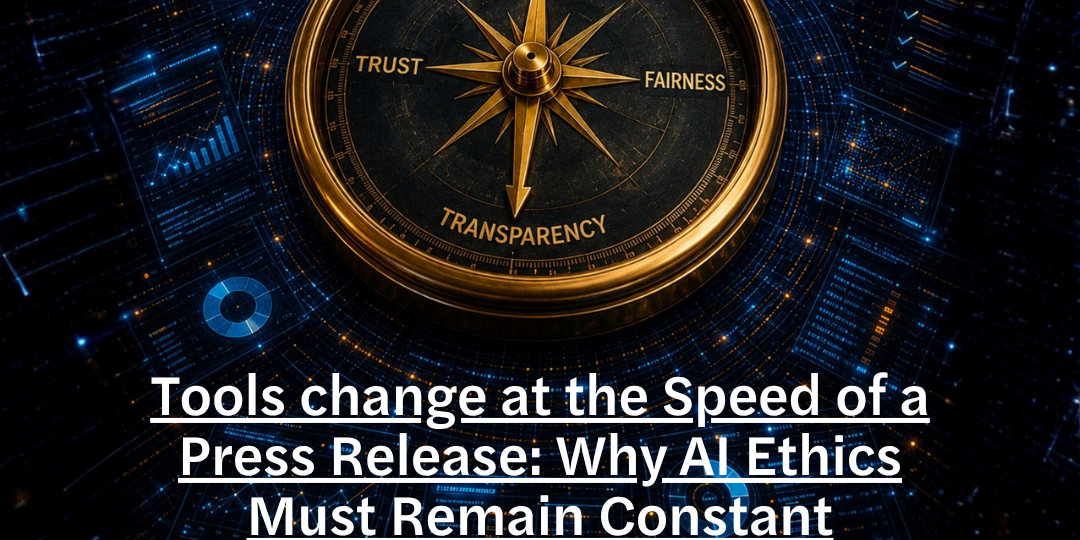
- Is the system fair?
- Is it transparent?
- Is there meaningful accountability?
- Are the outcomes aligned with the organization’s values?
- Is someone clearly responsible when things go wrong?
These are governance questions, not technology questions — and they remain relevant regardless of which model is being deployed, which vendor is being used, or which capability happens to dominate the conversation.
Organizations that anchor governance in principles gain an important advantage. They can evaluate new technologies without rewriting their standards. The technology changes, but the framework for evaluating it remains the same. This creates consistency in decision-making and clarity in oversight. More importantly, it prevents organizations from allowing excitement about innovation to override sound judgment.
The Danger of Ethical Drift
One of the less discussed risks associated with rapid AI adoption is ethical drift. Ethical drift occurs when organizations gradually adjust their standards to accommodate opportunities they would have questioned under different circumstances. The changes are often incremental. A small exception is granted here. A safeguard is relaxed there. A decision that once required careful review becomes routine. Over time, the organization’s standards shift without leadership fully recognizing what has happened.
Artificial intelligence creates ideal conditions for this problem because the pressure to move quickly is significant. Executives are told that speed creates competitive advantage. Teams are encouraged to experiment. Vendors emphasize opportunity while minimizing complexity. Every delay appears to carry a cost. Under those conditions, ethical standards can begin to feel negotiable.
Questions about accountability take a back seat to questions about deployment timelines. Concerns about transparency are viewed as obstacles to progress. Governance is framed as something that slows innovation rather than something that makes innovation sustainable. This is where leadership discipline becomes essential.
Organizations do not lose their way because of a single dramatic decision. More often, they lose their way by making a series of small compromises that gradually redefine what is acceptable. The purpose of ethical principles is to prevent that erosion. They provide a stable reference point against which every new opportunity can be evaluated.
Governance Requires Stable Reference Points
The most effective governance systems create consistency in environments characterized by uncertainty. They establish expectations before decisions become difficult. They define responsibilities before problems emerge. They create accountability before outcomes need to be explained. Artificial intelligence increases the importance of these disciplines.
As AI becomes embedded in hiring, performance management, customer engagement, risk assessment, and operational decision-making, organizations need a consistent framework for evaluating how these systems are used. That framework cannot depend on the technical characteristics of a particular model. It must be rooted in principles that remain applicable regardless of how the technology evolves.
Accountability should not change because a new model has been released. Transparency should not change because a new capability has emerged. Fairness should not change because a competitor is moving faster. The purpose of governance is to ensure that these principles remain intact even when external pressures encourage organizations to abandon them.
This is one reason many leadership teams struggle with AI adoption. They focus significant attention on understanding the technology while spending comparatively little time defining the standards that will govern its use. The technology matters. The standards matter more.
Leadership Provides Continuity
Organizations often portray innovation as the primary responsibility of leadership. Innovation is important, but it is not the primary responsibility. Leadership exists to provide continuity, direction, and accountability during periods of change. Artificial intelligence represents one of those periods.
The role of leadership is not to predict every technological development. It is to ensure that organizational values remain visible when new capabilities create pressure to compromise them. It is to establish governance structures that survive beyond individual products and market cycles. It is to create confidence that decisions will be evaluated consistently regardless of how quickly technology evolves.
This responsibility becomes even more important as AI systems gain influence over decisions that affect employees, customers, and communities. The more powerful the technology becomes, the greater the need for leadership discipline.
Technology can accelerate decisions, but it cannot replace judgment. Technology can improve efficiency, but it cannot assume accountability. Technology can generate recommendations, but it cannot determine organizational values. Those responsibilities remain where they have always belonged. They remain with leadership.
Closing Thought
Every generation of leaders encounters technologies that promise to change everything. Some fulfill that promise. Others fade into history. Artificial intelligence will almost certainly have a lasting impact on how organizations operate, compete, and create value. What should not change is the foundation upon which leadership decisions are made.
Organizations that tie governance to technology will spend their time constantly rewriting the rules. Organizations that tie governance to principles will be able to evaluate emerging technologies. One approach creates instability. The other creates resilience. Tools change at the speed of a press release. Ethical leadership does not.
The leaders who navigate the AI era most successfully will not be the ones who adopt every new capability first. They will be the ones to establish clear principles, govern consistently, and apply sound judgment, regardless of how quickly the technology around them changes.
So here is the question leaders should be asking themselves:
If the technology your organization relies on today became obsolete tomorrow, would the principles guiding its use remain strong enough to govern whatever comes next?